The Rise of the Digital Workforce
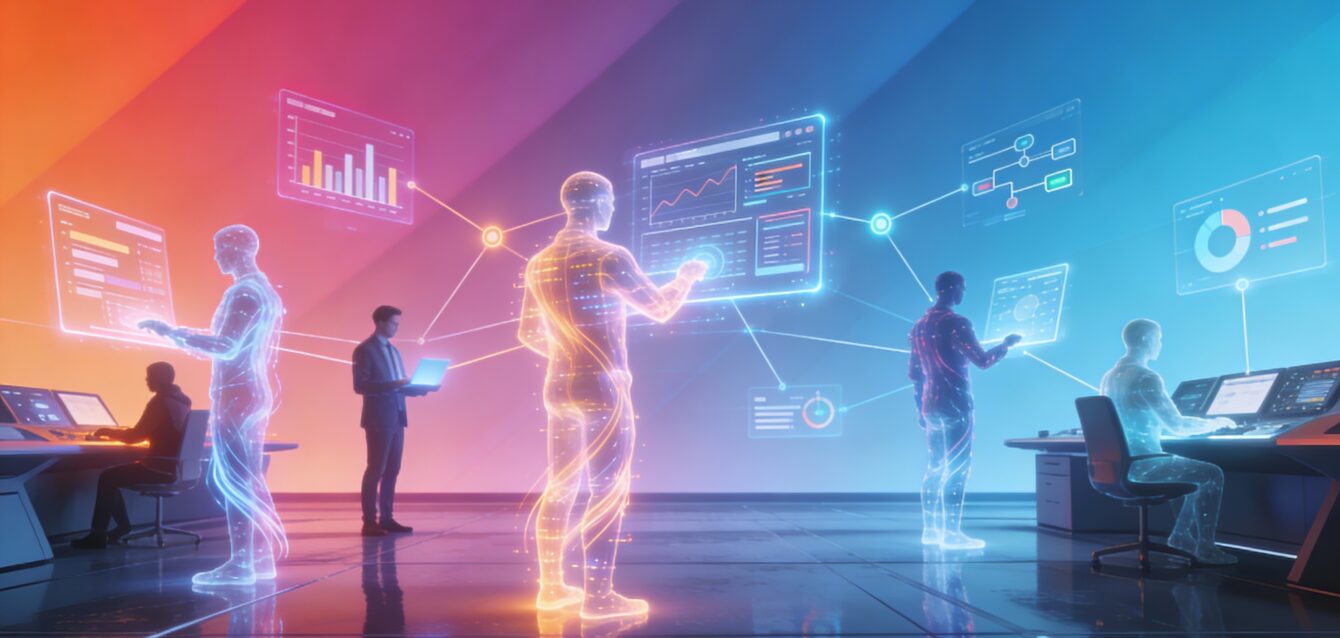
By 2026, the concept of a “single AI” has become obsolete for the modern enterprise. To handle the complexity of global markets and cross-channel customer journeys, organizations are deploying collaborative AI agents—specialized squads of intelligence that work together like a high-performing human department.
Multi-agent AI 2026 is not just about having more bots; it’s about creating an ecosystem where different agents possess unique skills, share a collective memory, and coordinate actions to solve problems that no single model could handle alone. This shift is turning AI from a simple tool into a distributed, autonomous workforce.
From Generalists to Specialist Squads
In previous years, companies tried to build “do-it-all” assistants. These often struggled with “context window” limitations or lost focus on complex tasks. The 2026 strategy favors a Modular Architecture:
- The Researcher Agent: Scours real-time web data and internal databases.
- The Analyst Agent: Processes raw data into actionable insights and financial projections.
- The Creative Agent: Generates cross-channel content (email, social, web) based on the Analyst’s data.
- The Compliance Agent: Audits all outputs against brand guidelines and local regulations.
According to IBM, this modularity allows for “Separation of Concerns,” ensuring each agent remains highly accurate within its specific domain while collaborating toward a shared goal.
Orchestrating Cross-Channel Tasks
The true value of collaborative AI agents is realized in tasks that span multiple platforms and departments. Consider a “Product Launch” workflow:
| Agent Role | Cross-Channel Responsibility | Primary Goal |
| Market Scout | Competitive analysis & trend monitoring. | Identify the ideal launch window. |
| Inventory Orchestrator | Connects ERP to logistics providers. | Ensure stock availability across regions. |
| Campaign Commander | Syncs CRM data with advertising platforms. | Deploy personalized messaging at scale. |
| Support Liaison | Monitors social media and help desks. | Resolve pre-launch inquiries instantly. |
For this to work, these agents must use a shared blackboard architecture or communication protocol—a “virtual meeting room” where they exchange status updates and hand off tasks. As The New Stack highlights, the development of standardized agent-to-agent communication protocols is the defining technical milestone of 2026.
Key Benefits of Multi-Agent Ecosystems
- Resilience: If one agent fails (e.g., a connection to a specific API breaks), the other agents can pivot or flag the issue without crashing the entire workflow.
- Scalability: You can add more “Worker Agents” to a team during peak periods (like Black Friday) without redesigning your core AI logic.
- Auditability: Because tasks are divided, it is much easier for human supervisors to see exactly where a mistake occurred.
To understand how to architect these systems from the ground up, explore our deep dive into Building Multi-Agent AI Ecosystems for Complex Business Tasks.
Managing the “Emergent Behavior” Risk
While collaborative agents are powerful, they introduce the risk of “emergent behavior”—unintended consequences arising from agent interactions.
Best Practices for 2026:
- Define Hierarchical Roles: Use a “Lead Agent” to act as the final decision-maker and conflict resolver.
- Implement Shared Memory: Ensure agents have access to a common vector database so they don’t work with conflicting information.
- Regular Human Audits: Even the most efficient teams require human strategic alignment. This is a core component of our Pillar Post: Navigating AI Agents in 2026.
Conclusion: The Future is Cooperative
The transition to multi-agent AI 2026 represents the next leap in business efficiency. By moving away from monolithic models and toward agile, collaborative teams, enterprises can automate cross-channel tasks with unprecedented precision. The companies that win in 2026 won’t have the “best AI”; they will have the best-coordinated AI teams.