
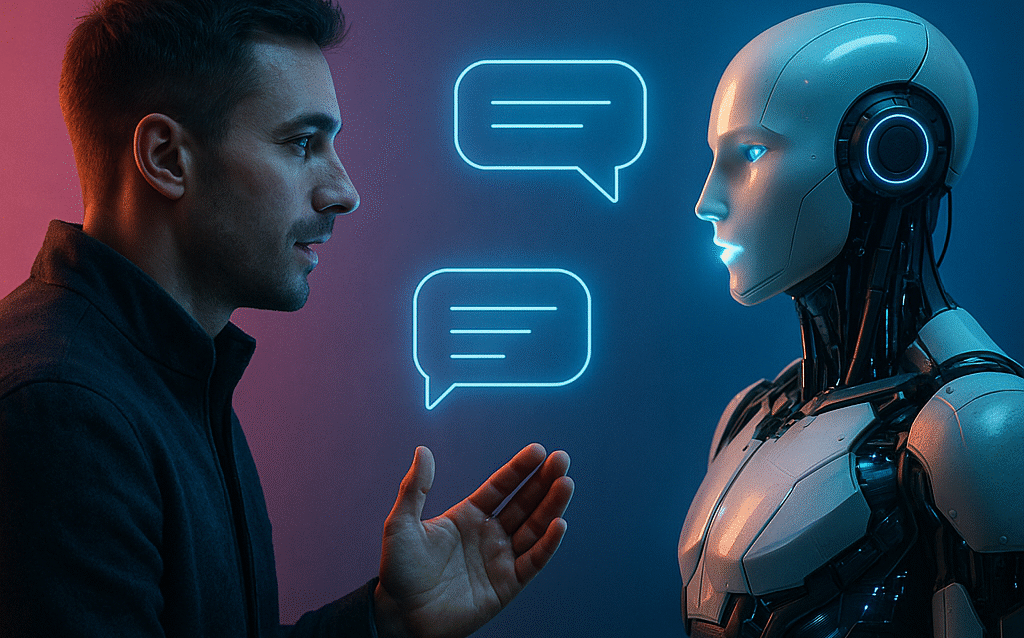
The Importance of Training AI Agents
Artificial Intelligence (AI) agents are becoming increasingly integral to how businesses interact with customers and streamline internal operations. However, the effectiveness of these agents hinges on one crucial element: training. A well-trained AI agent can engage in natural, helpful, and accurate conversations, leading to improved customer satisfaction, increased efficiency, and better overall outcomes. Conversely, a poorly trained agent can frustrate users and undermine trust. This post delves into the essential steps and techniques for effectively training your AI agent to have better conversations.
Data Collection and Agent Learning Methods
The foundation of any successful AI agent training lies in the quality and quantity of data it learns from. Several methods can be employed for data collection:
- Historical Conversation Logs: Analyzing past customer interactions (chat transcripts, call recordings) provides valuable insights into common queries, user language, and successful resolutions.
- FAQ Databases and Knowledge Bases: Existing documentation can be used to train the agent on standard answers and information.
- Simulated Conversations: Creating realistic dialogue scenarios that cover a wide range of potential user interactions.
- User Input During Beta Testing: Gathering feedback and real-world data from early users to identify areas where the agent needs improvement.
Once data is collected, the agent learns through various machine learning approaches:
- Natural Language Processing (NLP): Enables the agent to understand the meaning, intent, and context of human language.
- Machine Learning (ML): Algorithms that allow the agent to learn patterns from data and improve its responses over time without explicit programming.
- Deep Learning: A subset of ML that uses neural networks to process complex data and learn intricate relationships in language.
Training Techniques: Supervised vs. Unsupervised Learning
Two primary training techniques are commonly used:
- Supervised Learning: This involves providing the AI agent with labeled data – input examples paired with the desired output or correct answer. Human trainers play a crucial role in tagging and annotating data to guide the agent’s learning. For example, a user query (“How do I reset my password?”) would be labeled with the correct response. Supervised learning is effective for teaching the agent specific tasks and ensuring accuracy for known scenarios.
- Unsupervised Learning: This approach involves feeding the AI agent with unlabeled data and allowing it to identify patterns and relationships on its own. This can be useful for discovering new topics, segmenting user queries, and improving the agent’s understanding of language nuances without explicit human guidance. However, unsupervised learning often requires further refinement and validation.
In practice, a hybrid approach combining supervised and unsupervised learning often yields the best results, leveraging the accuracy of labeled data for specific tasks and the exploratory power of unlabeled data for broader understanding.
Improving Agent Accuracy with Feedback Loops
Continuous improvement is essential for maintaining and enhancing your AI agent’s conversational abilities. Implementing feedback loops is crucial for this:
- User Ratings and Feedback: Allow users to rate the helpfulness of the agent’s responses and provide free-text feedback on their experience. This direct input highlights areas where the agent excels or needs improvement.
- Agent Performance Monitoring: Track key metrics such as conversation success rate, task completion rate, and user sentiment. Identify patterns in unsuccessful interactions to pinpoint areas needing retraining.
- Human Agent Review: Regularly review transcripts of conversations handled by the AI agent, especially those that were escalated to human agents. This provides valuable insights into the agent’s limitations and areas for targeted training.
- A/B Testing: Experiment with different phrasing, response options, and conversation flows to identify what resonates best with users and leads to more successful interactions.
- Regular Retraining: Periodically retrain your AI agent with new data and updated information to ensure its knowledge base remains current and its conversational abilities continue to evolve.
Conclusion: Steps to Maintain Agent Quality Over Time
Training an AI agent for better conversations is not a one-time task but an ongoing process. To maintain and improve your agent’s quality over time, remember these key steps:
- Continuously Collect High-Quality Data: Regularly gather new conversation data, update knowledge bases, and solicit user feedback.
- Employ a Balanced Training Approach: Leverage both supervised and unsupervised learning techniques to maximize accuracy and adaptability.
- Implement Robust Feedback Loops: Actively solicit and analyze user ratings, agent performance metrics, and human agent reviews.
- Iterate and Optimize Regularly: Use data insights to refine conversation flows, update training data, and A/B test different approaches.
- Stay Updated with AI Advancements: The field of AI is constantly evolving. Keep abreast of new techniques and tools that can enhance your agent’s conversational abilities.
By prioritizing continuous training and optimization, you can ensure your AI agent becomes an increasingly valuable asset, capable of engaging in effective and satisfying conversations that drive positive outcomes for your business.