The Power of the AI Team
The first wave of AI introduced single-task agents—chatbots, translators, and basic automators. The next wave, however, is defined by collaboration. The most complex business challenges, like optimizing a global supply chain or launching an integrated marketing campaign, are too intricate for any single agent. The solution lies in building multi-agent AI ecosystems, where specialized, autonomous agents communicate and coordinate to achieve a high-level goal.
This informational post will demystify how these systems work, detailing the architecture required to deploy truly collaborative AI agents 2026 and showcasing how they tackle the complex, interconnected workflows that define modern business operations.
Understanding Multi-Agent AI Ecosystems
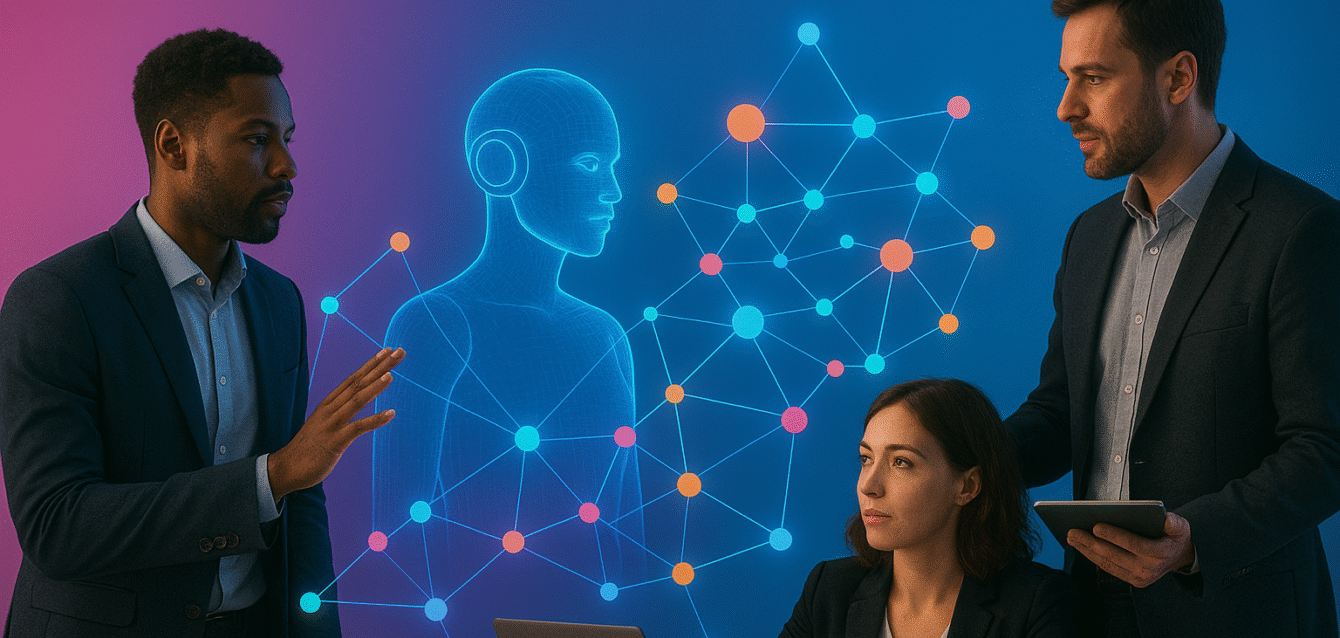
A multi-agent AI ecosystem is a distributed system where individual AI agents, each with its own expertise, memory, and toolset, work together as a cohesive team. Think of it as a specialized consulting firm where each agent fills a critical role—one is the data analyst, another is the strategist, and a third is the execution specialist.
The Core Principles of Collaboration
Successful collaborative AI agents 2026 rely on three foundational principles:
- Specialization and Delegation: Each agent is built for a specific function. For instance, in a supply chain, one agent might be the Inventory Manager (focused on stock levels), another the Logistics Optimizer (focused on routes and carriers), and a third the Risk Assessor (focused on supplier delays). The primary Agent (or “Orchestrator”) delegates tasks based on these specialties.
- Shared Communication Bus: Agents must be able to communicate effectively. This is often done via a central message queue or shared memory space where agents can publish findings (e.g., “Demand forecast just updated”) and subscribe to information relevant to their tasks. This ensures real-time coordination.
- Conflict Resolution: When two agents’ goals conflict (e.g., the “Cost Reduction Agent” wants to choose the cheapest, slowest carrier, but the “Customer Satisfaction Agent” demands fast delivery), the Orchestrator agent mediates, using a pre-defined set of business rules or a consensus mechanism to make the final, optimized decision. As Deloitte notes, managing these trade-offs autonomously is the key to enterprise-level AI efficiency.
Complex Application: Supply Chain Optimization
The supply chain is the perfect proving ground for multi-agent AI ecosystems because it involves numerous variables, dependencies, and stakeholders.
| Agent Role | Specialty and Focus | Collaborative Action |
| Demand Forecasting Agent | Predictive analytics, market trends, seasonality. | Generates the most accurate demand prediction and publishes it to the shared environment. |
| Inventory Manager Agent | Warehouse stock, carrying costs, reorder points. | Subscribes to the demand forecast, calculates necessary reorder quantities, and publishes a “Procurement Request.” |
| Procurement Agent | Supplier contracts, pricing, lead times. | Subscribes to the “Procurement Request,” negotiates price in real time with suppliers, and executes the purchase order. |
| Logistics Agent | Shipping routes, carrier rates, fuel costs. | Takes over when the product is shipped, continuously optimizing the transportation route based on real-time factors like traffic and weather. |
This orchestrated system ensures that every decision—from how much to order to how to ship it—is optimized against the current performance of the entire ecosystem, leading to massive AI cost reduction 2025.
Collaborative Applications Across the Business
The power of multi-agent AI ecosystems extends far beyond the supply chain.
- Financial Auditing: Agents can be deployed to check for financial compliance. One agent audits ledger entries, a second scans internal emails for risk factors, and a third cross-references regulatory changes. They collaborate to generate a comprehensive risk score far faster than human auditors.
- Integrated Marketing and Sales: Agents manage the entire funnel. A Marketing Agent runs ad campaigns, a Lead Scoring Agent qualifies prospects, and a Sales Agent manages personalized follow-ups. Their seamless collaboration ensures a smooth handoff and maximized conversion, a principle explored further in The Role of AI Agents in Multichannel Marketing: A Complete Guide.
- Software Development (DevOps): Agents collaborate to write code, test it, deploy it to a staging environment, and monitor its performance in production. This is often referred to as “AI-assisted DevOps,” significantly speeding up the product lifecycle. XCube Labs notes that these ecosystems drastically reduce time-to-market for software products.
Conclusion: Orchestrating the Future of Work
The future of complex business operations is collaborative. Building multi-agent AI ecosystems moves the focus from individual automation tasks to the autonomous achievement of strategic, enterprise-wide goals. By establishing clear specialization, communication protocols, and robust orchestrators, businesses can harness the full power of collaborative AI agents 2026 to solve problems of a scale and complexity previously unattainable. The next step is not just adopting an AI agent, but creating a high-performing AI team.