
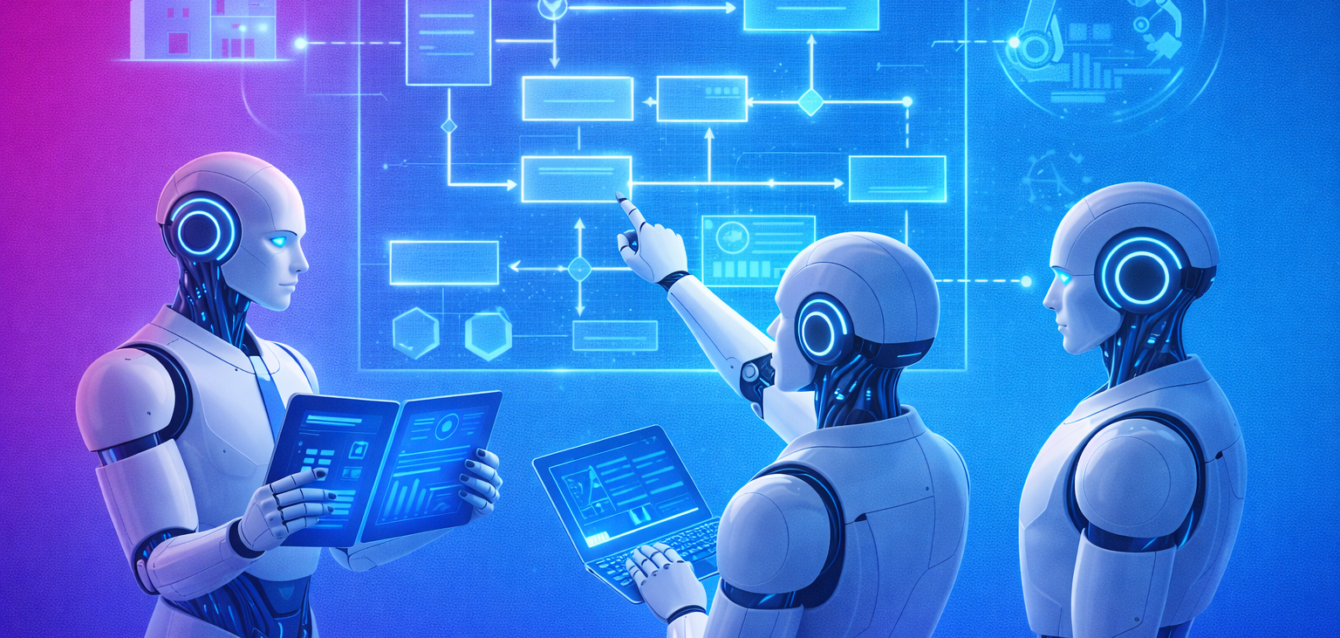
The Maturity of Autonomy
As we move through 2026, the honeymoon phase of AI experimentation has concluded. Organizations are no longer satisfied with isolated prototypes or simple Q&A bots. The current mandate is clear: transition agentic AI production 2026 standards from small-scale pilots into the core engine of industrial and commercial operations.
Moving agentic AI workflows into production involves shifting from “controlled environments” to the chaotic, real-time demands of global supply chains and complex logistics. This post explores the architectural shifts and strategic requirements for scaling agentic systems to handle your most mission-critical tasks.
The Evolution of Production Workflows
In early 2025, many AI applications were “human-triggered.” In 2026, we are seeing the rise of “event-triggered” autonomy. In production, an agent doesn’t just wait for a prompt; it monitors a data stream and acts when a threshold is met.
Why the Transition to Production is Challenging
- Interdependency: In a pilot, a failure is a bug. In production logistics, an agent making a wrong routing decision can cost thousands in fuel and delay global shipments.
- Dynamic Scaling: Google Cloud highlights that production-grade agents require infrastructure that can scale compute power instantly as agents branch into multi-step reasoning processes.
- State Management: Unlike simple LLMs, agents in production must maintain a persistent “state” across hours or days of a long-running workflow.
Case Study: Agentic AI in Global Logistics
Logistics is the ultimate testing ground for agentic AI production 2026. It requires the integration of diverse data: weather patterns, port congestion, fuel prices, and warehouse capacity.
How a Production Workflow Operates:
- Observation: An agent identifies a 12-hour delay at a major shipping port via real-time API feeds.
- Reasoning: The agent queries the ERP for high-priority shipments in the affected containers.
- Planning: It calculates the ROI of rerouting via air freight versus waiting for port clearance.
- Action: The agent drafts a rerouting proposal, contacts the carrier for a quote, and sends a notification to the logistics manager for final approval.
This level of sophistication is what distinguishes modern workflows from the basic concepts discussed in our introductory guide, Demystifying Agentic AI: Key Concepts and Business Applications for 2026.
Requirements for Scalable Production Workflows
To move beyond the pilot phase, your architecture must support three critical functions:
1. Reliability and Error Handling
In production, “hallucinations” are not an option. Systems must include deterministic check-points. For every autonomous step, a governance layer must validate the output against physical constraints (e.g., an agent cannot order more inventory than a warehouse can hold).
2. The Multi-Agent Orchestration Layer
Complex tasks are rarely handled by a single agent. Production environments utilize specialized agents—one for data retrieval, one for cost calculation, and one for compliance. As IBM notes, the “orchestrator” agent is the most critical component, acting as the project manager for the digital workforce.
3. Continuous Feedback Loops
A production agent must learn from its environment. If a suggested logistics route consistently results in delays, the agent’s “long-term memory” module must flag this pattern and adjust future planning logic.
Strategy for Success: The 2026 Roadmap
Transitioning to production is a marathon, not a sprint. To ensure a high ROI, refer to our Post: Navigating AI Agents in 2026 for a comprehensive look at long-term adoption strategies.
- Step 1: Identify the “Bottleneck Task”—the complex workflow where human decision-making is currently the slowest link.
- Step 2: Shadowing—Run the agent in “shadow mode” where it makes decisions that are recorded but not executed, allowing you to measure accuracy against human experts.
- Step 3: Gradual Autonomy—Slowly increase the agent’s spending or decision-making limits as confidence scores improve.
Conclusion: The Future is Production-Ready
The leap from pilot to production is where true competitive advantage is forged. By building agentic AI workflows that are resilient, governed, and integrated into the physical realities of business—like logistics—enterprises can move beyond the hype and deliver tangible value. In 2026, the most successful companies aren’t just “using AI”; they are running on it.